
B2B buyers rarely ask an AI search just an abstract question like “Which providers are there?“. They want to know whether a solution fits into their existing system landscape, which requirements must be met, which risks remain – and how a benefit can be verifiably demonstrated.
This makes the search faster. The information landscape does not automatically improve.
A Gartner survey of 645 B2B buyers shows the tension: In a recent purchasing decision, respondents used an average of seven information sources; 45 percent used GenAI primarily for vendor and product research. At the same time, 69 percent want to validate AI-generated insights with sales staff. AI search therefore does not replace expert review. It only shifts when and on what basis it begins.
This is where Generative Engine Optimization comes in – a new marketing discipline with the task of providing expertise in such a way that people, search systems, and AI-powered answers can understand it, verify it, and use it for the next decision.
Short answer: Generative Engine Optimization, or GEO for short, describes the work on content, sources and technical foundations so that a company is understandable and verifiable in AI-powered search and answer systems. GEO builds on accessible, indexable and helpful pages and adds the question of whether important technical information is clearly explained, substantiated and usable for specific research.
1. What GEO is – and what it is not
2. How GEO differs from SEO, AEO and LLMO
3. Why GEO becomes relevant in complex B2B decisions
4. The EPOS response architecture
5. Website, PR and LinkedIn as a shared system
6. What GEO deliberately cannot do
7. How a realistic GEO pilot project begins
The term Generative Engine Optimization is not yet as uniformly established as SEO. In the market, GEO, Answer Engine Optimization (AEO), Large Language Model Optimization (LLMO) and Generative AI Optimization (GAIO) are sometimes used side by side. The terms set different emphases. The practical question behind them is the same: Does a target group find clear, accessible and verifiable information for important decisions?
Generative search systems combine information from multiple sources. For its search features, Google describes, among other things, retrieval-augmented generation: current pages from the search index are retrieved and used as the basis for an answer. With query fan-out, the system can break down a complex initial question into related sub-questions and retrieve additional sources for them. Google explains these mechanisms in its guide to generative search features.
For a B2B company, this does not mean covering every conceivable variant of a question with its own short text. It means understanding the questions that actually recur in research and building a reliable information base for them.
GEO is therefore not a collection of technical tricks. An llms.txt file, artificially split text sections, or special “GEO markup” do not solve the core problem. According to Google, no additional AI files or special markup are required for Google's generative search features. The known prerequisites remain relevant: pages must be reachable, crawlable, and indexable; they must offer real informational value for people and fit sensibly into a website.
The technical foundation creates access – but only professionally sound answers create relevance.
SEO remains the foundation that enables search engines to find, understand and serve a page in their results. GEO expands this perspective to include the question of whether information can be meaningfully classified by AI-powered research and answer systems. AEO places greater emphasis on directly answering specific questions. LLMO focuses on large language models and their information environments.
| Term | Practical focus | Relevance for communication teams |
|---|---|---|
| SEO | Findability, technical accessibility and organic search results | Ensures that important pages can be found and processed in the first place. |
| GEO | Understandable, verifiable presence in AI-powered search and answer environments | Connects content, sources, expertise and technical foundation along a customer question. |
| AEO | Direct answers to specific questions | Helps to answer core questions early and understandably. |
| LLMO / GAIO | Classification of information in the environments of large language models | Useful terms for monitoring, but not a separate tool category for editorial teams. |
The terms do not need to be defended against each other. For communications managers, what counts is the shared core: a clear statement, a traceable proof, a clean structure, expert review, and a technically reachable page.
Short answer: SEO makes content findable. GEO extends this foundation with the question of whether expert knowledge for AI-supported research is understandable, current, and connected with reliable sources. AEO, LLMO, and GAIO describe adjacent perspectives. In B2B practice, they lead to the same basic tasks: answer relevant questions, make evidence visible, and maintain the technical foundation.
In a complex investment, no buying center researches only “the best product“. The specialist department asks about benefits and usage conditions. IT evaluates interfaces, data flows, or security requirements. Procurement and management review risk, effort, and cost-effectiveness. What begins as a single search query branches into multiple information tasks.
This dynamic is increasing. Forrester reports for 2026 that a typical purchasing decision now involves 13 internal stakeholders and nine external influencers; for more complex or strategic procurements, the number rises. Procurement is involved in the decision in 53 percent of the purchasing cycles examined.
Should you now write a separate article for each role? In most cases, that does not make sense – but a product page with a feature list alone is no longer enough either. Every important piece of information must enable the next meaningful evaluation step: Which requirements are relevant? Which selection criteria distinguish solutions? Which evidence supports the statement? Where are the limits?
Let's imagine a provider of production planning software. A potential customer asks: „Under what conditions can production planning be digitalized step by step without overburdening existing systems?“ The production manager is interested in processes and acceptance in operations. IT asks about interfaces and data quality. Management needs a robust logic for benefits, effort and risk. A good answer page does not have to overload these perspectives. But it should make visible which conditions must be checked and which experts can assess the details.
Short answer: GEO becomes relevant in B2B because purchasing decisions rarely hinge on a single piece of information. The specialist department, IT, procurement and management review different requirements and evidence. A robust answer explains when a solution can fit, what the statement is based on and what still needs to be clarified before a decision.
For the editorial team, GEO is above all a way of working. It does not begin with a prompt or a keyword list, but with a customer question that genuinely recurs within the company. This produces an answer that does not hide behind general benefit claims.
The EPOS answer architecture bundles six building blocks for this purpose:
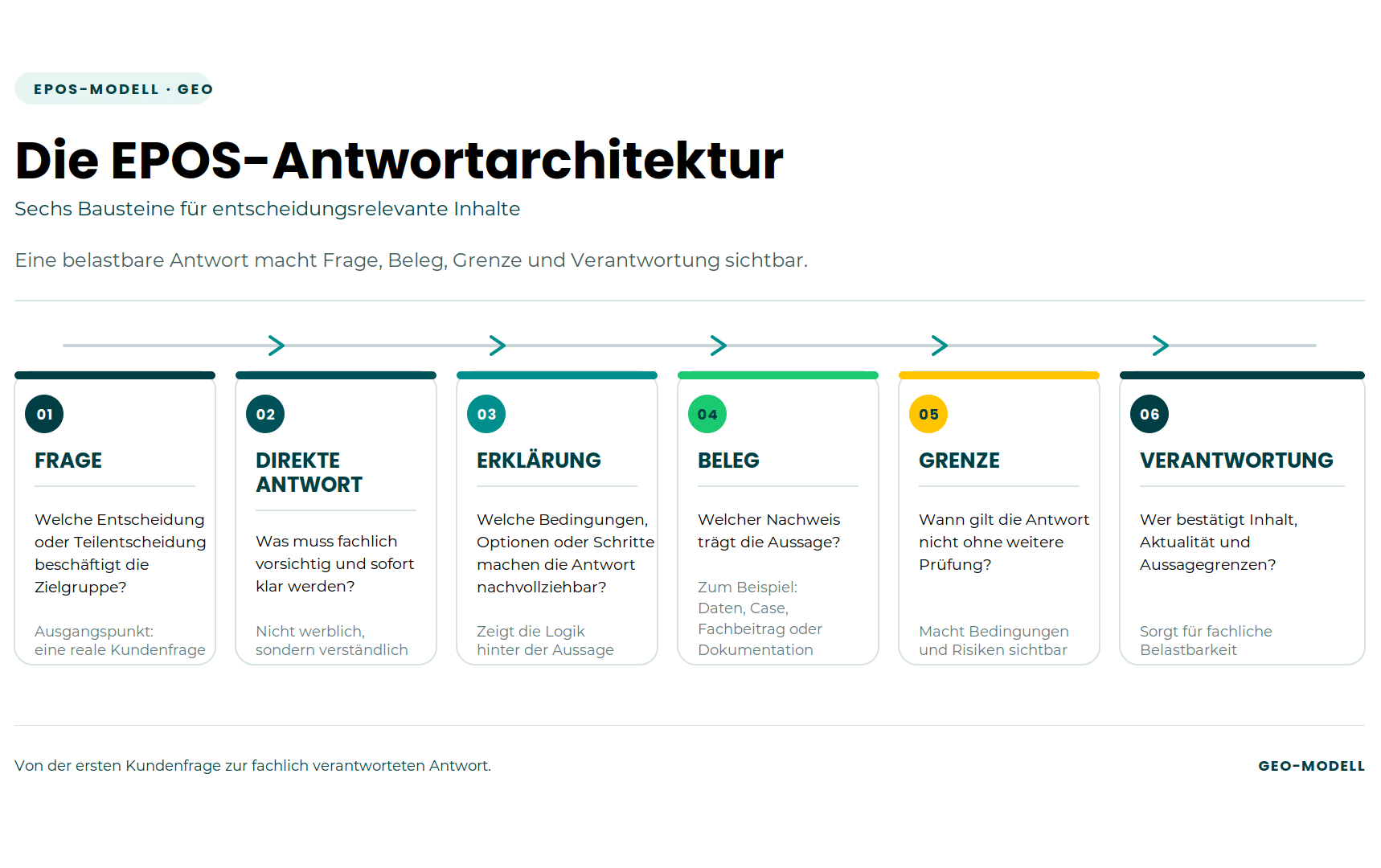
Click to enlarge | Graphic created with AI support and editorially reviewed
| Building block | Guiding question | Example for production planning |
|---|---|---|
| Question | Which concrete decision or partial decision is occupying the target group? | How can an existing production planning system be digitalized step by step? |
| Direct answer | What is the short, professionally cautious answer? | Feasibility depends, among other things, on data quality, interfaces, roles, and the migration phase. |
| Explanation | Which prerequisites or steps explain this answer? | Existing processes, master data, integration with ERP/MES, and approvals must be reviewed. |
| Evidence | Which evidence supports the statement? | Approved integration process, technical documentation, verified case, or reliable data point. |
| Limit | When does the answer not apply without further review? | A statement about duration or effort cannot be generalized without knowledge of the system landscape and target state. |
| Responsibility | Who confirms content, timeliness, and the limits of statements? | Product management, engineering, or project management review the technical statement before publication. |
This order is important. Those who begin with a product message often formulate only their own benefit. Those who begin with a question must decide which answer is truly defensible. The evidence prevents a claim from floating in the text. The limit makes visible that costs, duration, integration effort, or security can rarely be assessed without conditions.
The SISTRIX analysis of the 100 websites most frequently cited in Google AI Mode repeatedly describes clear answer structures, visible authority, topicality and technical readability for these pages. This is not a blueprint for every B2B page. However, it supports a pragmatic observation: an answer must be designed so that people and systems can understand its subject, its evidence and its scope of responsibility.
1. Choose a question from sales, a specialist department, a webinar, a trade fair or website search that keeps coming up.
2. Place the product page, technical article, sales collateral, and existing evidence side by side.
3. For each building block of the answer architecture, mark: available, to be updated or missing.
4. Name a subject matter expert for the statement and the update date.
5. Only then decide whether the gap should be closed on the website, in an in-depth article, or with a PR or LinkedIn follow-up.
The check does not replace a major audit, but it turns diffuse GEO interest into a reliable to-do list. At the same time, it moves away from the idea that every content gap must be addressed with a new article. Often the most effective measure is a good existing page that adds a missing condition, a proof point, or an internal link.
Currently, individual channels and disciplines are often portrayed in the marketing industry as disproportionately important for GEO. This is a misunderstanding: website, press relations, and LinkedIn have different tasks. Their connection does not arise from the same content being played out three times. It arises when all three support a shared customer question from their respective roles.
| Channel | Editorial task | What the role cannot replace |
|---|---|---|
| Website | Complete, updatable answer with criteria, evidence, sources, and meaningful deeper dives | Independent assessment by third parties |
| Press relations / Earned Media | Independent insights, data, or expert classification on a relevant industry occasion | The complete explanation of your own offering |
| A limited, professionally responsible perspective and a reference to a source for deeper exploration | A robust answer page with details, evidence, and updates |
The website is the answer base. It can be updated, linked with sources, and placed into a meaningful research path via internal links. This is exactly where B2B SEO and work on decision-relevant B2B content come in.
Media relations create additional context when a topic goes beyond your own product announcement. A relevant industry occasion, a substantive contribution of your own, and a person who can provide expert information are a better starting point than a mere wish for mentions. The Muck Rack analysis from May 2026 found that among more than 25 million citation links from answers by ChatGPT, Claude, and Gemini across 17 industries, 84 percent was earned media. Paid and advertorial content accounted for 0.3 percent; journalistic sources for 27 percent. This underscores the function of independent contextualization.
More on this: B2B PR for expert classification and earned media.
LinkedIn can bring expertise into the ongoing discussion and point to a more in-depth source. The Semrush study from March 2026 analyzed 325,000 prompts and 89,000 unique cited LinkedIn URLs. In their sample, LinkedIn appeared in an average of 11 percent of responses. Primarily original, knowledge- and advisory-oriented content was cited. For B2B teams, a recommendation can be derived from this: An expert should publish a statement that they can professionally stand behind and lead to reliable context.
For the operational platform logic, see also B2B LinkedIn and expert positioning.
Short answer: Website, PR and LinkedIn have different tasks in a GEO strategy. The website carries the complete, updatable answer. Press work can create independent context. LinkedIn makes a defensible expert perspective visible and leads to deeper information. What matters is their connection along the same customer question.
GEO can improve the conditions for visibility, source citations, or appropriate classification. It cannot guarantee any individual brand mention, any citation in a specific system, or any recommendation. Answers change depending on the question, language, country, timing, and available sources.
Teams should therefore avoid four oversimplifications:
„A special GEO markup is enough.“ For Google's generative search features, Google does not require new markup or an llms.txt file. Structured data remains useful within the framework of a general SEO strategy, but it is not a shortcut in AI answers.
„AI only needs short text chunks.“ Google does not specify an ideal page length. A page should be structured so that readers can find their answer; artificial fragmentation alone does not create added value.
„More brand mentions automatically bring AI visibility.“ Inauthentic mentions do not help. What matters more are helpful content, genuine sources, and a traceable contribution to a question.
„A mention is the only success.“ Brand mention, source citation, and recommendation are different outcomes. For B2B, what matters is whether a page meaningfully supports further research, internal alignment, or sales validation.
The same applies to measurement: A manual prompt query can provide interesting insights, but it is only a snapshot. It should be combined with Search Console data, organic impressions and clicks, follow-up visits to relevant service pages, CTA clicks, and feedback from sales or the specialist department. For its generative search features, Google points to the Generative AI performance report in Search Console.
A first GEO step does not have to be a comprehensive transformation of the website. It should improve a prioritized customer question and establish a way of working that teams can repeat.
Week 1–2: Clarify questions and responsibilities
Collect three to five recurring questions from sales, the specialist department, webinars, trade shows, Search Console, and internal website search. Prioritize one question that is relevant to a real decision. Early on, designate a subject matter expert who can review prerequisites, evidence, and limitations.
Week 3–4: Review existing answers
Place existing pages, sales materials, webinars, cases, and data sources side by side. The answer architecture shows whether a page merely claims a benefit or already delivers a verifiable answer. Decide what needs to be revised, supplemented, or rebuilt.
Week 5–8: substantially improve one answer page
Revise or create a page that answers the question directly, connects explanation and evidence, and contains clear next steps. Keep the author, expert review, and update date visible. For helpful content, Google recommends clear sources, recognizable expertise, and information about who created or reviewed a piece of content. The relevant quality questions can be found in Google's guide to helpful, reliable, and people-first content.
Week 9–12: Organize follow-up and the learning loop
Check whether the answer has a suitable LinkedIn connection or whether it can give rise to a standalone media opportunity. After that, monitor not only rankings or individual AI answers, but also search queries, qualified interactions, internal redirects, sales questions, and the need for updates.
Practical conclusion: A good GEO pilot project begins with an important customer question, not with a tool. Review existing content, sources, and responsibilities. Then substantially improve one answer page and, if needed, connect it with PR or LinkedIn. Measurement remains a learning loop – not proof of a single AI citation.
GEO does not change the fact that buyers need evidence, context, and expert reassurance. It makes clearer how early this information can feed into research.
For communications managers, the task is therefore not to manage yet another AI tactic. They organize the connection between questions from the market, professionally defensible answers, existing evidence, and the appropriate channels. SEO and the web team create the technical accessibility. Subject matter departments verify the substance. Sales knows recurring decision-making questions. Communications connects these contributions into an information base that holds up even outside a sales conversation.
Would you like to check which questions your existing content answers convincingly – and where evidence, updates or connections are missing? Request a GEO potential analysis for B2B technology companies.
What is Generative Engine Optimization (GEO)?
Generative Engine Optimization describes the work on content, sources and technical foundations so that a company is understandable and verifiable in AI-powered search and answer systems. GEO builds on SEO and adds the question of whether important technical information on specific customer questions is clearly explained, verified and usefully linked.
Does GEO replace classic search engine optimization?
No. SEO remains the foundation for ensuring that content is crawlable, indexable, and visible in search. GEO expands this foundation with the question of whether expertise is also understandable, up to date, and supported by appropriate evidence in AI-powered research.
Can a GEO strategy guarantee mentions in ChatGPT or Google AI Overviews?
No. Answers and sources from generative search systems differ depending on the question, language, country, time, and available sources. GEO improves the conditions for helpful, findable, and verifiable content, but it guarantees neither a single brand mention nor a source citation or a recommendation.
How does a B2B company start with GEO?
Start with a recurring customer question from sales or a specialist department. Then check whether an existing page answers the question directly, which evidence is missing, who is professionally responsible for the statement, and which deeper dive makes sense. A small pilot project with a clear question is more helpful than many uncoordinated AI formats.
